
Shopping online has never been easier than it is right now. The pandemic saw more and more people turn to mobile and online shopping, and now it’s a key part of the modern consumer journey. In 2020, mobile sales grew by 46% in the US, and Amazon added roughly 50 million new subscribers across 2020 and 2021. And, while in-store shopping is back, the long-term effects of the pandemic are clear to see.
We love mobile apps and cashless payments, and more people are willing to buy large purchases online than ever before. Big-ticket items like furniture and electronics are now readily available to buy online. And what was once a consumer journey that spanned hours or weeks has become something much more fragmented.

Unlock watching browsing and buying.
What does the modern consumer journey look like?
Online shopping and rapid delivery has become the norm for the modern consumer, and their attention has become spread across multiple devices at once. And it’s not just shopping online: consumers are researching products quickly before moving on to something new. Today’s consumers move rapidly between states of watching, browsing and buying, taking in new information, marketing signals and recommendations from social media, and making purchases online, across multiple devices at the same time.
Online shopping has made buying a transitory state
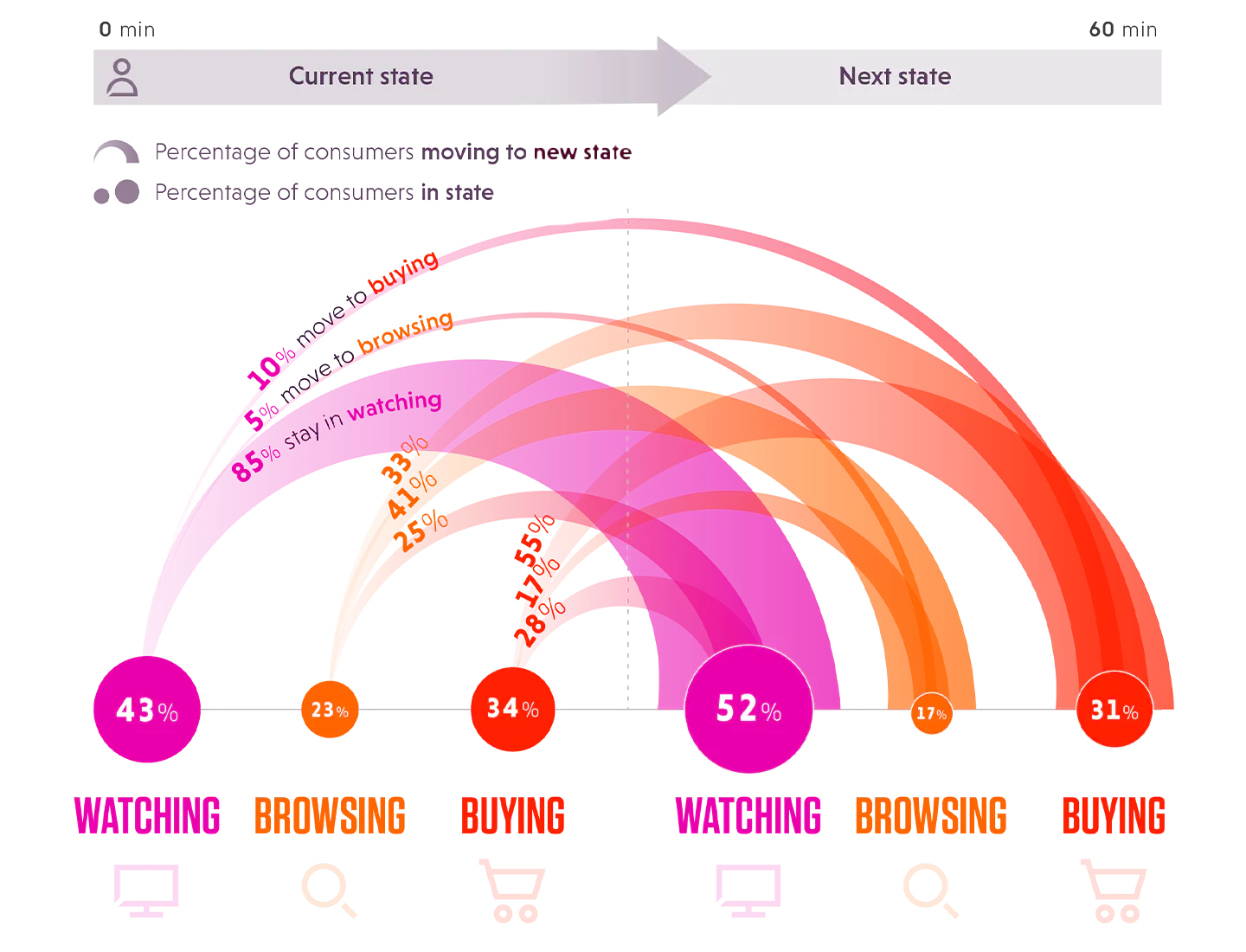
Buying is an active consumer state, but also one that often happens at the same time as browsing and watching. According to our ‘From funnel to flexibility report’, 34% of consumers are in a buying state at any given moment: browsing products, adding them to carts, or finalizing purchases. Within the same hour, 17% will move to browsing and 28% will move to watching. And consumers are more likely to move from watching to buying (18%) than from watching to browsing (3%).
Nearly half (47%) of consumers using a mobile device while watching video are shopping online - browsing online stores, researching products, checking prices, or buying something.
Online shopping on a second screen
We’ve all heard the stories of Netflix creating shows that cater to the second screen audience. These aren’t just rumours: there’s plenty of data to back it up. Half of adults say they frequently use another device while watching, and half of those say they’re shopping online.
This is big news for both content producers and advertisers. Your audience is always reachable, even when they’re watching ad-free content. More importantly, their mindset isn’t firmly in the watching state: they may shift to buying, causing them to potentially forget what they were watching and/or shopping for, and then re-read, re-browse or rewind.
However, consumers still believe that they’re taking linear paths to purchase. 54% believe they follow a rational, step-by-step process before making big purchases. They spend their time bouncing around online and between screens, but mentally feel locked in on their major purchase. Only 9% believe they make big purchases impulsively, and 42% say that their path is more random.
Some of this is generational. Older consumers are more likely to say that they still follow a step-by-step process for making big purchases - and that lines up with those consumers being less likely to ping-pong between different screens.
How do people use AI while shopping?
Nearly half (45%) of consumers say they’ve used a tool like ChatGPT or Gemini when making purchases.
AI is playing a bigger role in these purchases now. Nearly half (45%) of consumers say they’ve used a tool like ChatGPT or Gemini as a sort of AI shopping assistant. The most common uses are comparing products and brands (27%), asking for gift ideas and recommendations (18%), and summarizing reviews (16%). AI shopping is most prevalent among consumers ages 18-34. Older consumers prefer to use AI for shopping to compare products and brands, while younger consumers will ask it for recommendations.
How can advertisers tap into consumers’ split attention?
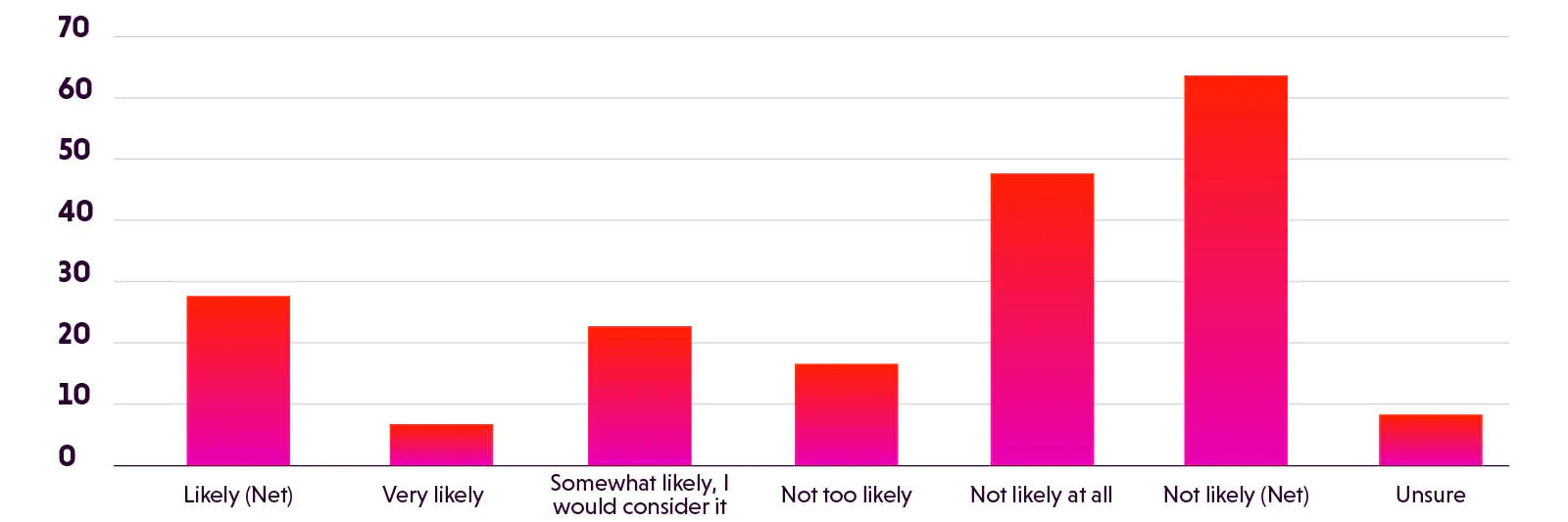
70% of consumers say they get distracted while researching new products and come back to buy something later
The fragmented consumer journey can work both ways for advertisers. While it provides an opportunity to reach consumers when they’re otherwise engaged with ad-free content, it also means their divided attention is easy to short-circuit. More than 70% of consumers say they get distracted while researching new product purchases, and return to their online shopping later after being reminded or triggered by something new.
Video is a key part of this process for brands, even if their attention is divided: 71% of consumers say they discover brands they like while watching video content. (Even if they aren’t shopping.) And this jumps to 95% for consumers in the 18-24 age group.
It’s clear that consumers are far more susceptible to advertising and product messaging when watching content than they realize. But catching those moments is critical. A smart brand strategy has to be able to react quickly to the rapidly shifting consumer states. In these multi-screen environments, having AI-based tools to plan and execute media plans is a must.
How can MiQ Sigma tap into the buying stage of the consumer journey?
That’s where tools like MiQ Sigma come in. Sigma brings the latest advanced AI models together with a Data Spine of 700+ trillion signals related to consumer browsing, buying, and watching to make decisions. Sigma can unify your data, media, and platforms to decode the modern consumer and drive faster, more customized decisions about your media buys to truly move the needle on your business goals.


